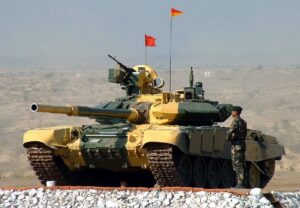
NEW DELHI — On 27 September 2026, the Ministry of Defence published a fact sheet that charted India’s progress in building a self‑reliant defence industry. The document outlined a 15‑year plan to increase domestic production of key weapons systems and to reduce dependence on imports for critical components. The same week, US Ambassador Sergio Gor travelled to Rajasthan to observe Yudh Abhyas 2026, a large‑scale joint exercise that demonstrated the depth of the India‑US defence partnership.
Domestic Production Gains
The fact sheet, released by the Press Information Bureau (PIB), lists several milestones achieved in the past year. It notes that the Defence Production Hub in Gujarat has begun serial production of the 5‑G radar system, a technology that was previously imported. The document also reports that the Indian Navy’s indigenous shipyard in Visakhapatnam has completed the construction of the first of three new stealth frigates, a project that had been slated for 2024.
According to the PIB release, the Ministry has increased its defence budget allocation to ₹1.5 trillion for 2026‑27, a 12% rise from the previous fiscal year. The budget earmarks ₹400 billion for research and development of next‑generation aircraft and ₹300 billion for upgrading the Army’s artillery systems. The fact sheet stresses that these investments aim to meet the “self‑reliance” target set by the National Defence Policy of 2021.
Yudh Abhyas 2026: A Showcase of Indo‑US Cooperation
Yudh Abhyas 2026 was conducted in the Thar Desert of Rajasthan from 20 to 25 September. The exercise involved more than 10,000 Indian troops and a comparable contingent from the United States. It included joint air‑borne operations, naval drills in the Arabian Sea, and ground manoeuvres that tested interoperability between the two militaries.
US Ambassador Sergio Gor, who has served in New Delhi since 2024, travelled to the exercise site on 22 September. In a statement released by the Indian Embassy, the ambassador said that the exercise “reinforced the strategic partnership between the two countries and highlighted India’s growing capability to conduct complex joint operations.” The statement also noted that the exercise was part of a broader Indo‑US defence dialogue that began in 2020.
Strategic Implications for National Security
The fact sheet frames India’s self‑reliance drive as a response to shifting geopolitical dynamics in the Indo‑Pacific. It cites the increased frequency of maritime patrols by the United States in the region and the growing presence of China’s naval assets as key motivators for strengthening domestic production.
In addition to the production milestones, the document highlights the establishment of a joint research centre in Bengaluru that focuses on autonomous weapons systems. The centre is a collaboration between the Defence Research and Development Organisation (DRDO) and the Indian Institute of Technology (IIT) Bombay. The centre’s first prototype, a low‑cost unmanned ground vehicle, was unveiled during a press briefing on 15 September.
Industry and Policy Response
Industry leaders welcomed the PIB fact sheet. The Confederation of Indian Industry (CII) released a statement on 28 September that praised the government’s “commitment to fostering a robust defence manufacturing ecosystem.” The statement also called for further incentives for private‑sector participation.
Policy analysts noted that the increased budget allocation and the Yudh Abhyas exercise together signal a shift toward a more integrated defence strategy. The Ministry’s fact sheet also mentioned a new procurement policy that allows for a 30% local content requirement in all future acquisitions of high‑tech weaponry.
Looking Ahead
The Ministry of Defence has announced that the next phase of the self‑reliance plan will focus on the development of indigenous missile systems and the expansion of the Defence Production Hub in Chennai. The plan also includes a partnership with the United Kingdom to co‑develop a new class of destroyers.
As India continues to expand its defence manufacturing base, the Yudh Abhyas 2026 exercise stands as a tangible demonstration of the country’s growing operational capabilities and its deepening ties with the United States. The combined efforts are expected to enhance India’s deterrence posture in a region marked by rapid military modernization.