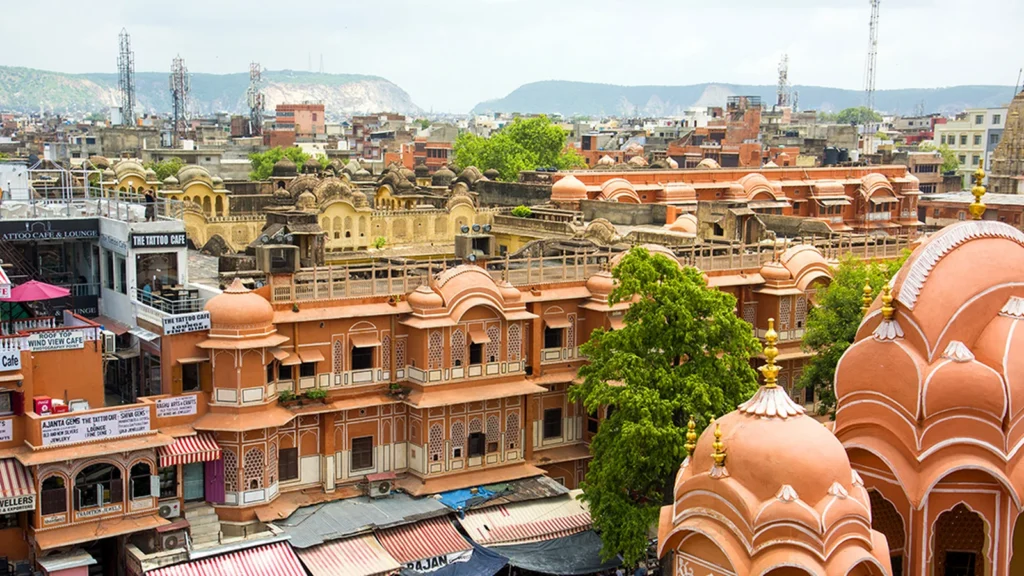
JAIPOUR — The Rajasthan High Court issued a stern warning on Tuesday that the city of Jaipur risks losing its UNESCO World Heritage status if the state government fails to implement comprehensive remedial measures for its historic structures by December 2026. In a suo motu case, the bench directed the state administration to present a detailed action plan addressing structural decay, unauthorized encroachments, and inadequate maintenance of heritage sites within the designated World Heritage Zone.
Court directs detailed remedial plan
The bench, comprising Justice Rameshwar Singh and Justice Sanjay Kumar, noted that the current state of preservation in the Pink City is inconsistent with the obligations undertaken by India under the World Heritage Convention. The court observed that several havelis, bazaars, and public monuments within the heritage zone are in a state of disrepair, posing risks to both public safety and the integrity of the cultural landscape.
“The heritage status is not a permanent entitlement but a conditional recognition that requires continuous stewardship,” the court stated in its order. The judges emphasized that the state must demonstrate tangible progress in conservation efforts, rather than relying on periodic inspections or superficial repairs.
Context of heritage erosion
Jaipur was inscribed on the UNESCO World Heritage List in 2019 as part of the ‘Hill Forts of Rajasthan’ extension, recognizing its unique urban planning and architectural heritage. However, conservation experts and civic bodies have long raised concerns about the rapid urbanization and lack of enforcement of heritage building codes in the city core.
Recent incidents, including a massive fire at the UNESCO-recognized Parkota Bazar, have highlighted the vulnerability of these structures. The fire, which damaged several historic shops and storage units, underscored the inadequacy of fire safety infrastructure in narrow heritage lanes. According to reports, the incident exposed gaps in municipal oversight and the absence of modern fire suppression systems in older buildings.
ThePrint, in a recent analysis, noted that despite the UNESCO tag, many havelis and bazaars in Jaipur are disappearing due to neglect, private ownership disputes, and the high cost of restoration. The publication argued that the designation has not translated into effective protection mechanisms, with many structures being demolished or altered without proper authorization.
State government response
The Rajasthan government, through its Department of Culture and Tourism, has acknowledged the court’s concerns. A senior official stated that a task force has been constituted to assess the condition of all heritage structures within the World Heritage Zone. The task force is expected to submit its preliminary findings by the end of October, with a full remedial plan to be presented to the court by December.
The state has also indicated that it will seek technical assistance from the Archaeological Survey of India (ASI) and international conservation experts to develop a sustainable maintenance framework. This includes the installation of modern fire safety equipment, structural stabilization of critical monuments, and the enforcement of strict building regulations in the heritage zone.
Legal implications and future steps
UNESCO has previously placed several Indian heritage sites on its List of World Heritage in Danger, citing issues such as urban sprawl, pollution, and inadequate management. If Jaipur is added to this list, it could lead to the withdrawal of international funding and technical support, further complicating conservation efforts.
The court’s order is seen as a significant intervention in the governance of cultural heritage in India. It sets a precedent for judicial oversight in the preservation of World Heritage sites, holding state governments accountable for their stewardship responsibilities. The bench reserved its judgment on the specific penalties for non-compliance, stating that it would decide on further measures after reviewing the state’s remedial plan.
Conservationists have welcomed the court’s intervention, calling it a necessary step to protect Jaipur’s cultural identity. However, they have also urged the government to involve local communities and heritage organizations in the planning process to ensure that the remedial measures are both effective and socially inclusive.