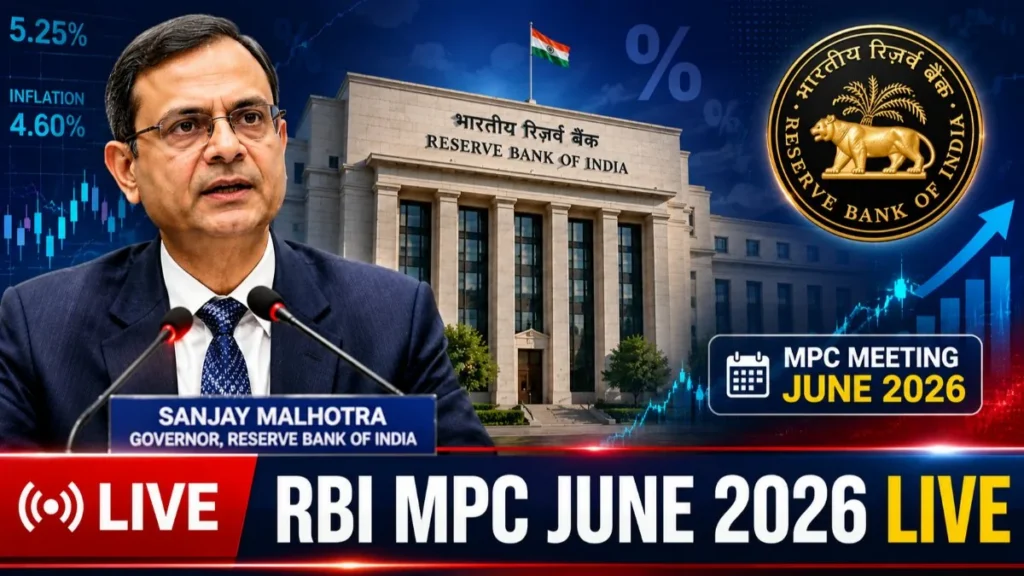
NEW DELHI — The Reserve Bank of India (RBI) on Wednesday kept the repo rate unchanged at 5.25%, maintaining a neutral stance on monetary policy as it navigates a complex macroeconomic landscape. In its latest Monetary Policy Committee (MPC) decision, the central bank also revised its Gross Domestic Product (GDP) growth forecast for the financial year 2026-27 (FY27) downward to 6.6%, while raising its inflation projection to 5.1%.
The decision, announced by Governor Sanjay Malhotra, reflects the RBI’s continued focus on price stability amid lingering supply-side shocks and global economic headwinds. The MPC voted unanimously to hold the policy rate, signaling that the central bank is not yet ready to pivot toward easing despite recent softening in some inflation indicators.
Growth Outlook Revised Downward
The RBI’s downward revision of the FY27 growth estimate from its previous projection underscores concerns over slowing domestic demand and global trade disruptions. The central bank noted that while the services sector continues to show resilience, the manufacturing and construction sectors have faced headwinds due to elevated input costs and global supply chain bottlenecks.
“The growth outlook for FY27 remains subject to risks on both sides, with global uncertainties and domestic policy implementation playing a critical role,” the MPC statement read. The bank highlighted that the 6.6% growth rate assumes a stable global environment and continued structural reforms in key sectors.
Inflation Concerns Persist
The upward revision of the inflation forecast to 5.1% for FY27 indicates that the RBI views price pressures as more entrenched than previously estimated. Food inflation, particularly in volatile items such as vegetables and pulses, has remained a key driver of headline inflation. The central bank noted that while core inflation has moderated, the persistence of high food prices poses a challenge to achieving the 4% target within the medium-term framework.
“The MPC is of the view that inflation is likely to remain above the target in the near term, necessitating a cautious approach to monetary policy,” the statement added. The bank emphasized that it will continue to monitor global commodity prices and domestic demand trends closely.
Market Reaction and Expert Analysis
Financial markets reacted mildly to the RBI’s decision, with the benchmark Nifty 50 index trading flat in the early hours of trading. Bond yields also remained stable, reflecting investor expectations that the central bank would maintain its current stance. Currency markets saw minimal movement, with the rupee holding steady against the US dollar.
Economists noted that the RBI’s decision aligns with global central bank trends, as several major economies have also paused rate cuts amid persistent inflation. “The RBI’s focus on price stability is justified given the current inflationary environment,” said a senior economist at a leading research firm. “However, the downward revision in growth highlights the need for coordinated fiscal and monetary policies to support economic activity.”
Future Policy Stance
The RBI indicated that its future policy decisions will be data-dependent, with a close watch on inflation trends, global economic developments, and domestic policy reforms. The bank reiterated its commitment to achieving the 4% inflation target over the medium term while supporting sustainable economic growth.
The next MPC meeting is scheduled for late September 2026, where the central bank will assess the latest economic data and global developments to determine its next policy move. Analysts expect the RBI to maintain its neutral stance in the near term, with any potential rate cuts dependent on a sustained decline in inflation.
Primary Sources & Official Records
- RBI MPC June 2026 LIVE: Repo Rate Held at 5.25%, FY27 Growth Cut to 6.6%,Inflation Raised
- Industry Well Positioned for Cash Treasury Central Clearing – Markets Media
- Guayaquil City FC Liga Dep. Univ. Quito 30 August 2026 Live Score and Match Summary – Yeni
- Reserve Bank hikes rates by 25 basis points, citing inflation risks. – fullview.co.za