NEW DELHI — The Indian Army has requested heavier armour protection for the Zorawar light tank, a move that industry analysts warn could lead to major delays in the programme and necessitate costly engine upgrades. The request, detailed in a recent analysis by Defence.in, highlights the tension between the military’s desire for enhanced survivability and the strict weight constraints inherent to the vehicle’s design for high-altitude operations.
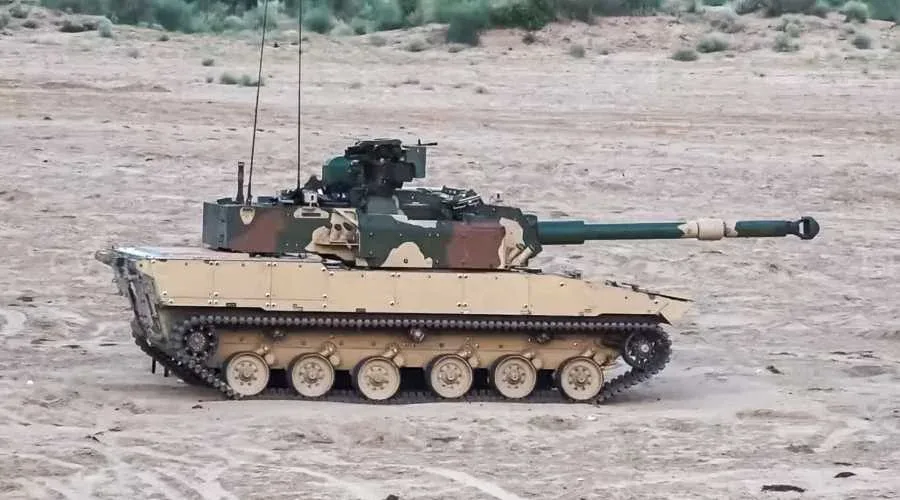
The Zorawar, developed by the Defence Research and Development Organisation (DRDO) and being manufactured by the Ordnance Factory Board, is designed to weigh approximately 37 tonnes. This weight limit is critical for the tank to operate effectively on the fragile mountain roads and bridges of the Line of Actual Control (LAC) and the Line of Control (LoC), where heavier main battle tanks like the Arjun Mk1A cannot be deployed. The vehicle is intended to provide the Indian Army with a mobile, fire-capable platform for the northern theatre, countering similar light armoured vehicles fielded by neighbouring countries.
According to the analysis, the Army’s new requirement for increased ballistic and blast protection directly conflicts with the existing weight budget. Adding armour plating or composite materials to the hull and turret will inevitably increase the vehicle’s gross weight. To maintain the 37-tonne limit, the Army would likely need to reduce the payload, such as ammunition load or fuel capacity, or seek a more powerful engine to compensate for the added mass. The current Zorawar is powered by a 500-horsepower engine, which is considered adequate for its current weight profile but may struggle if the vehicle becomes significantly heavier without a corresponding power increase.
Engine upgrades present a complex logistical and financial challenge. The Zorawar’s powerpack is a critical component, and changing it would require extensive re-engineering, re-testing, and certification. This process could add years to the development and induction timeline. The programme has already faced delays, with the first batch of tanks expected to be inducted in the late 2020s. Any further slippage could leave a capability gap in the northern command, where the Army relies on a mix of older light tanks and infantry support vehicles.
Industry experts note that the Army’s insistence on heavier armour reflects lessons learned from recent conflicts and the evolving threat landscape in the Himalayan region. The risk from anti-tank guided missiles (ATGMs) and improvised explosive devices (IEDs) has increased, making basic armour insufficient for crew survival. However, the trade-off between protection and mobility is a classic dilemma in light tank design. A heavier, better-armoured vehicle may be less agile and more vulnerable to ambushes in narrow mountain passes, while a lighter, faster vehicle may be more susceptible to direct fire.
The DRDO and the Ordnance Factory Board have not publicly commented on the Army’s new requirements. However, officials have previously stated that the Zorawar programme is on track and that any changes to the requirements would be evaluated based on their impact on the overall project timeline and cost. The Ministry of Defence is expected to review the Army’s request and issue a revised Statement of Requirements (SOR) if the changes are deemed necessary. This process could take several months, further delaying the finalisation of the production contract.
The Zorawar is part of the Indian Army’s broader effort to modernise its armoured forces. The Army has also been pushing for the development of a new main battle tank, the Arjun Mk2, and the procurement of additional T-90S tanks from Russia. The light tank segment is crucial for the Army’s high-altitude operations, where the weight and mobility of the vehicle are as important as its firepower. The Zorawar is expected to be equipped with a 105mm gun, a 7.62mm coaxial machine gun, and a 7.62mm roof-mounted machine gun. It will also have a fire control system, night vision capabilities, and a ballistic protection system.
The potential delays in the Zorawar programme could have wider implications for the Indian Army’s force structure. The Army has been planning to raise new light tank battalions for the northern command, and the induction of the Zorawar is a key component of this plan. Any slippage in the programme could force the Army to delay the formation of these battalions or to rely on older, less capable vehicles for a longer period. The Army has also been exploring the use of unmanned ground vehicles (UGVs) for some of the roles that the Zorawar is intended to fill, but these systems are not yet mature enough to replace a manned light tank in the near term.
The analysis by Defence.in underscores the challenges facing the Indian defence industry in meeting the Army’s evolving requirements. The need for faster development cycles, greater modularity, and more flexible design approaches is becoming increasingly apparent. The Zorawar programme is a test case for the industry’s ability to deliver a complex, high-tech weapon system on time and within budget. The outcome of the Army’s request for heavier armour will be a key indicator of the programme’s future trajectory.
Primary Sources & Official Records
- Analysis – Indian Army Seeks Heavier Armour for Zorawar Light Tank, Risking Major Delays a
- Ukraine’s army seeks to give frontline commanders more authority – The Economic Times
- Unfit due to small kidney: Karnataka High Court dismisses Army aspirant’s plea – indianexp
- Army seeks industrial partners to modernise 12 ordnance depots – The Tribune