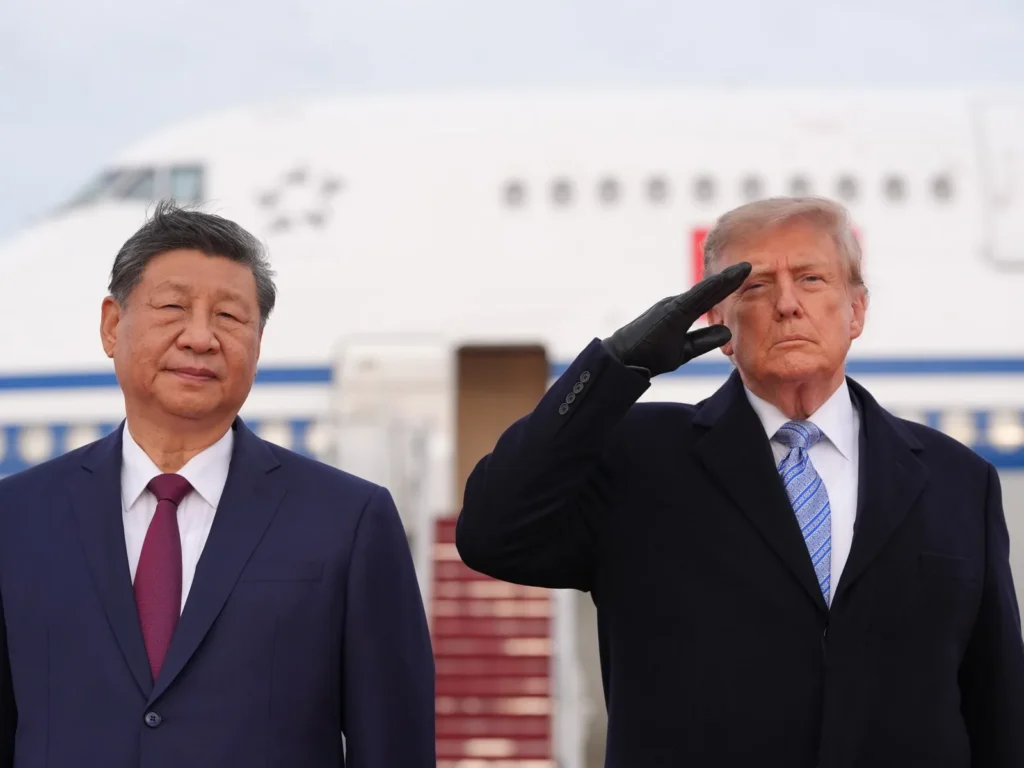
WASHINGTON — US President Donald Trump departed the White House on Wednesday to personally greet Chinese President Xi Jinping at Joint Base Andrews in Maryland, a rare diplomatic protocol that signaled the high stakes of the Chinese leader’s three-day state visit to the United States. The tarmac greeting, accompanied by a military flyover, marked a significant shift in bilateral engagement following months of escalating tensions over trade tariffs, semiconductor restrictions, and geopolitical security.
Xi Jinping and his wife, Peng Liyuan, arrived at the air base shortly after 10:00 a.m. Eastern Time. Trump, accompanied by Vice President JD Vance and Secretary of State Marco Rubio, met the Chinese delegation on the tarmac. The two leaders shook hands and exchanged brief remarks before boarding a motorcade heading to the White House. This direct, personal greeting is a diplomatic honor typically reserved for heads of state from close allies, underscoring the US administration’s intent to reset the bilateral relationship amid ongoing economic friction.
Trade truce and technology talks
The visit is expected to focus primarily on stabilizing US-China trade relations. According to officials briefed on the agenda, the two leaders are set to discuss a potential trade truce that would pause or reduce reciprocal tariffs imposed in early 2026. The US has maintained strict export controls on advanced artificial intelligence chips and semiconductor manufacturing equipment, a policy Beijing has repeatedly criticized as an attempt to contain its technological advancement.
“We are here to find common ground,” Trump told reporters at the White House before departing for the airport. “The relationship is too important to let it deteriorate further. We have a lot of work to do, but I believe we can make progress.” Xi Jinping, in a statement released by the Chinese Foreign Ministry, described the visit as an “opportunity to deepen mutual understanding and promote practical cooperation” in areas of shared interest, including climate change and global supply chain stability.
Historic diplomatic protocol
The decision to greet Xi on the tarmac was a deliberate break from recent norms. In previous high-level meetings, US presidents have typically welcomed foreign leaders at the White House or in formal state dinners, but rarely at the airport. This gesture mirrors the protocol used during the 2017 visit of then-President Xi to the US, when President Donald Trump also greeted him at the airport. However, the current political climate is markedly different, with both nations navigating complex alliances in the Indo-Pacific and competing for dominance in the AI sector.
Diplomatic sources indicated that the visit was the result of months of back-channel negotiations. The US and China have engaged in a series of technical and economic talks in Geneva and London, which laid the groundwork for this high-level summit. The three-day itinerary includes a state dinner at the White House, bilateral meetings with congressional leaders, and a joint press conference on Friday.
Geopolitical implications
Analysts note that the visit carries significant implications for the broader global order. The US and China are the world’s two largest economies, and their relationship directly impacts global markets, energy prices, and technological standards. A successful trade truce could alleviate inflationary pressures in the US and provide a boost to Chinese exports, which have faced headwinds due to domestic economic slowdowns and external demand shifts.
However, challenges remain. The US Congress has expressed skepticism about any significant concessions on technology exports, citing national security concerns. Meanwhile, Beijing has maintained its stance on Taiwan, a core issue that continues to strain relations. The visit is expected to be closely watched by allies in Europe, Japan, and South Korea, who are concerned about the potential for a US-China rapprochement that could marginalize their strategic interests.
The White House has emphasized that the visit is not a signal of a complete policy reversal but rather a pragmatic approach to managing competition. “We compete where we must, but we cooperate where we can,” said a senior administration official. The joint statement, expected to be released on Friday, is anticipated to outline specific steps toward de-escalation, including the establishment of a working group on AI governance and a review of tariff exemptions for critical goods.
As the motorcade arrived at the White House, crowds gathered on Pennsylvania Avenue to watch the arrival. The scene marked a moment of rare normalcy in a relationship that has been defined by volatility and strategic rivalry in recent years. The next 72 hours will test whether the diplomatic gesture translates into tangible policy outcomes.
Primary Sources & Official Records
- Trump greets China’s Xi Jinping on arrival for three
- Trump greets Xi Jinping at plane as Chinese leader arrives for state visit – The Guardian
- Trump greets China’s president on tarmac with flyover to kick off 3-day US visit – WJAR
- Trump greets China’s Xi at airport in historic move — as nations agree to trade truce to k